
Jessup, MD
Maryland Bioenergy Center
Food waste recycling and renewable natural gas
The Maryland Bioenergy Center was built beside a major food distribution hub. Its digesters turn food-processing and distribution waste into renewable gas and leave a material that can be used to make soil products. [1] [2]
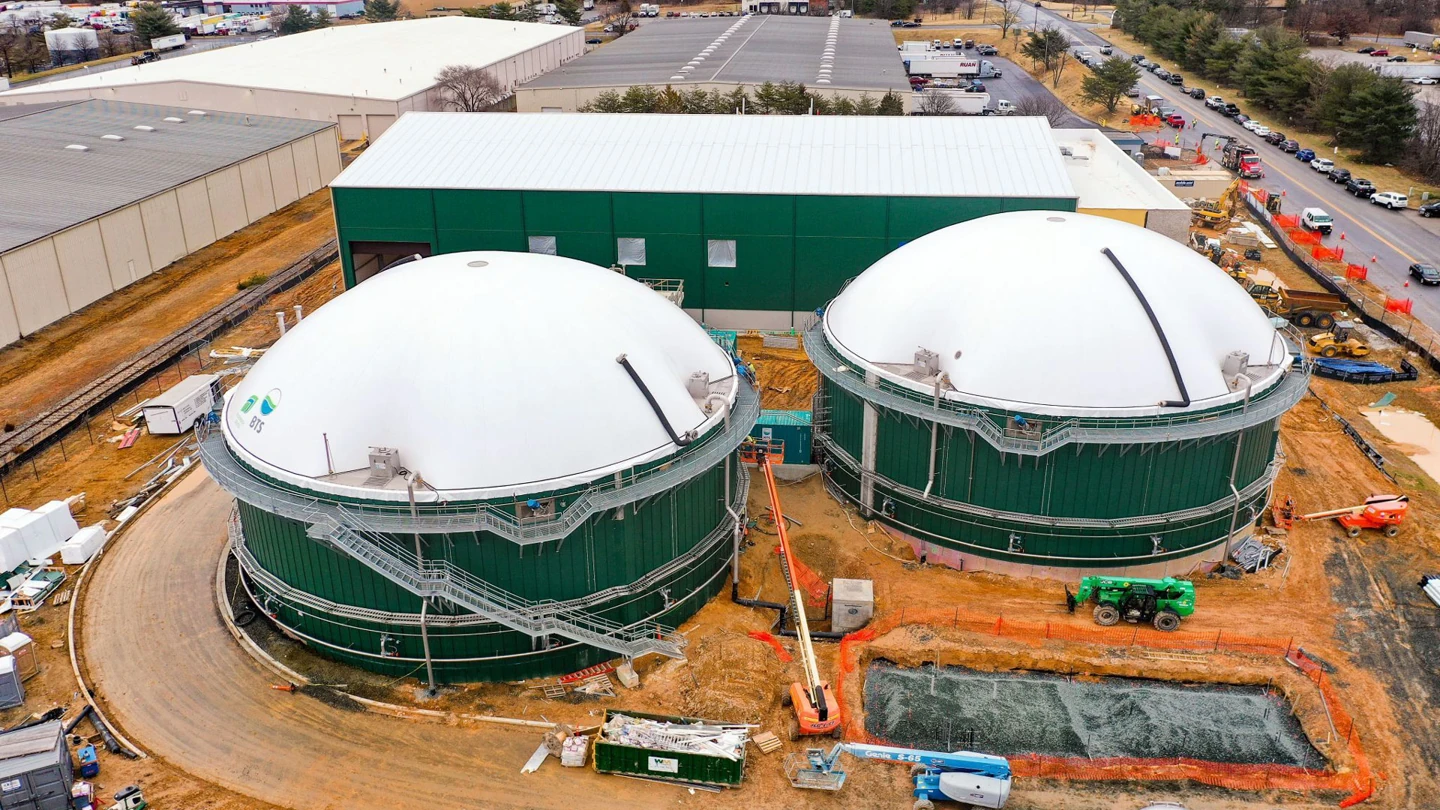
- Anaerobic treatment vessels [3]
- 2 digesters
- Volume per digester, per project consultant [3]
- 1.2M gallons
- Food waste processing estimate [4]
- 125,000 tons/yr
- Consultant-reported installed cost [3]
- $20M
Why it happened
The Maryland Food Center brings wholesalers, processors, and distribution businesses together. Locating digestion next to the campus gives area businesses a way to recycle organic material that would otherwise have to be managed off site. [1] [4]
What was built
Food waste enters sealed tanks where microorganisms break it down without oxygen. The process produces biogas that can be upgraded to renewable natural gas. The remaining digestate can be used to make soil products. [1] [2] [3]
What changed
The project created a regional destination for food waste and a source of renewable gas. The annual figure is the processing estimate in Maryland Environmental Service’s report. It describes expected throughput. [4] [1]
Project team
Project photos
Site location
See the two digesters beside the processing building at the Maryland Food Center in Jessup.
Project records
-
Maryland Department of Commerce · Jessup digester
Developer, project purpose, and the food waste-to-gas process.
-
BTS Biogas · Maryland Bioenergy Center
Technology, eligible organic materials, and renewable gas applications.
-
Industrial Projects Consulting · Jessup biogas project
Number and volume of digesters and installed cost reported by the project consultant.
-
Maryland Environmental Service · Greenhouse gas report
Expected food waste diversion, stated in tons per year.
-
American Concrete Institute · Building partners
Engineer, general contractor, and concrete delivery team.
-
M2 Construction · Maryland Food Center
Concrete construction project record and photographs.